“When did we
build our house?”
Plans, invoices and photos help establish a timeline. The answer takes you back to the evidence behind it.
DOCUMENTS + PHOTOSPhotos in albums. Letters in drawers. Memories in your mind. “Frag dein Leben” — German for “Ask your life” — aims to bring them together in a personal archive you can talk to.
Discover the life archive ↓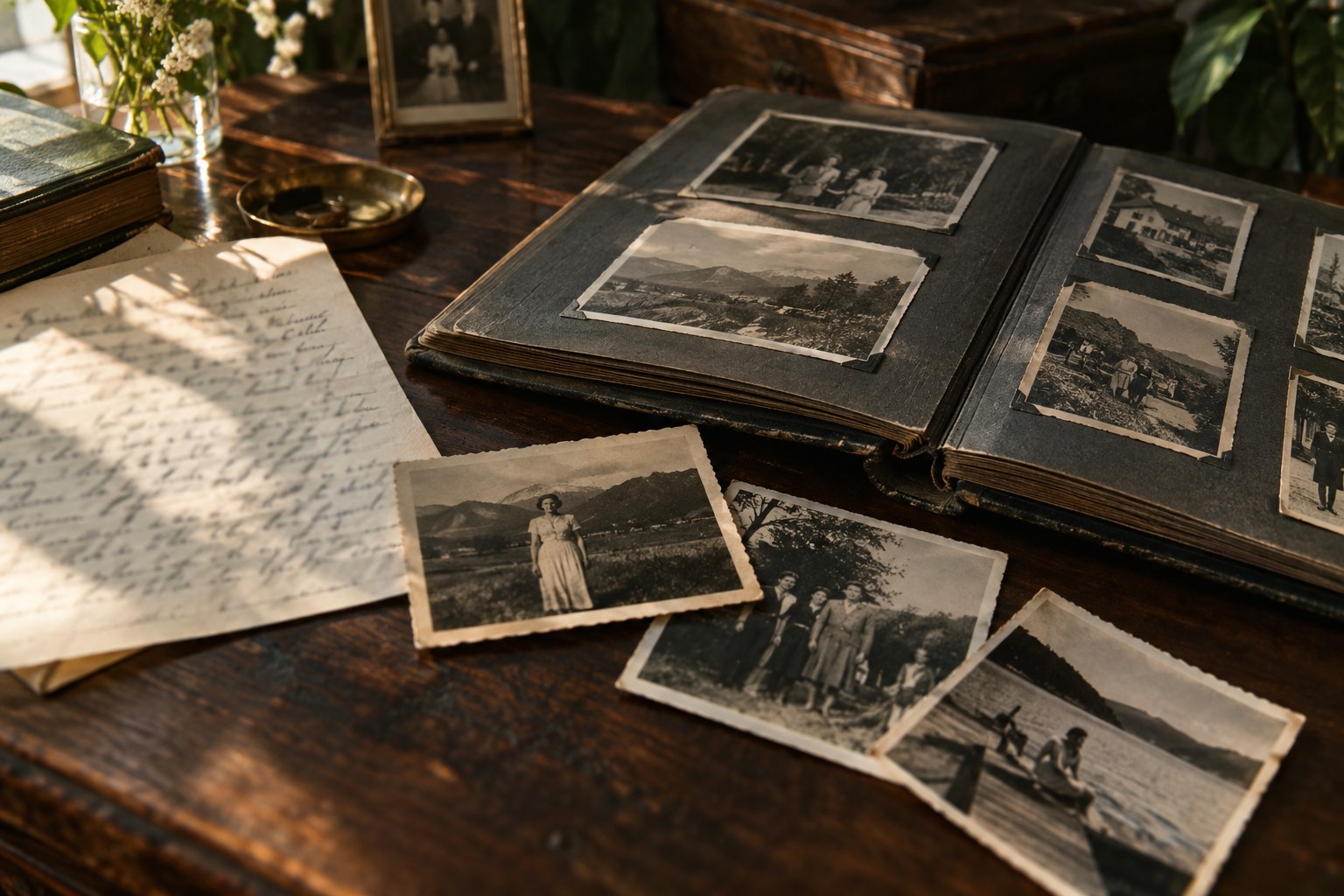
A personal life archive preserves more than files. It helps you rediscover the knowledge and stories within them.
Ask about a journey, building your home or meeting someone. The planned archive searches the material you have permission to access and brings relevant pieces together: a photo, an invoice, an email or a recorded memory.
Originals are preserved. Answers show the sources behind them. When something is unclear, the archive should ask a question or openly acknowledge the uncertainty.
This is what exploring your archive could feel like.
Plans, invoices and photos help establish a timeline. The answer takes you back to the evidence behind it.
DOCUMENTS + PHOTOSImage content, locations and available dates help you find the right photos. Unknown people are not simply given names.
IMAGES + PLACESA voice recording preserves the original voice alongside an editable transcript. Links to photos are planned for a later stage.
VOICE + STORYIllustrative examples of planned features — not real archive data or a live demo.
You bring the memories.
The archive helps you explore them.
Scan documents, import files and photos, add emails or record a memory in your own voice.
Each original receives a unique reference and information about its origin. Searchable text and previews complement it.
Text recognition, speech transcription and search indexes make content discoverable. You confirm important associations.
Ask a question in your own words. The archive finds relevant material and shows exactly where it comes from.
You don’t have to digitise everything at once. The planned approach starts with a manageable collection and grows as you use it.
The story behind a photo deserves a place, too.
Letters, certificates, contracts, invoices, drawings and plans. Text should become searchable while the original files are preserved.
Digital and scanned photos, along with personal videos. Dates, locations and confirmed identities help you find them again.
Messages with their sender, date and attachments, plus digital documents. Their origins and related content stay connected.
Voice recordings with original audio and editable transcripts. Your voice, expression and personal perspective are preserved, too.
You don’t need to know which folder holds a story.
The plan includes a clear web interface with large text, accessible source cards and a visible way to correct errors. An initial messaging integration should provide another way in.
The web interface is the central place for searching, viewing originals and accessing sensitive content. Core local features should work without internet or cloud AI.
Questions, photos, documents and voice messages should be as easy to send as a message to a contact. One selected messaging service is planned for the first pilot; further integrations will be assessed later.
Tell a memory instead of writing it down. The recording is preserved, and the resulting transcript can be corrected.
Messaging services need internet access. Messages pass through the provider; using local AI does not make that transmission local.
Your own hardware. Deliberate sharing. Answers you can check.
These principles are requirements for the planned implementation. Access controls and recovery must be verified before the archive goes into everyday use.
The AI should not invent facts about your life. Uncertain dates, conflicting memories and missing evidence remain visible. A suggested association is only confirmed when you approve it.
Content should only be accessible when permission has been granted — including in search results and answers. Family access with different permissions is planned for a later stage.
The plan includes encrypted drives and backups, a separate copy at another location and regular recovery tests. It also requires someone responsible for maintenance and emergency access.
It is switched off by default in the concept. Optional use should only follow explicit approval to share specific content.
An AI assistant acts as a conductor: coordinating searches, bringing relevant results together and pointing to their sources. Throughout, it respects which content you are allowed to access.
The planned system connects a document archive, a photo and video archive, and a shared search facility. Local AI helps interpret text and images. Speech recognition turns spoken memories into searchable text.
The privately installed appliance should bring together originals, archive management and AI processing. Its hardware is matched to the size of your archive and how you want to use it. Storage needs and performance are checked before use.
These features describe how the planned parts of the life archive work together.
The current project plan describes a concept. It does not document an application that is already complete.
The pilot should show whether people can find documents without help and record memories easily.
These stages need separate planning and are not included in the initial technical pilot.
“Frag dein Leben” is planned as an appliance: a dedicated device with the software for your life archive, installed in your home.
People who want to bring personal documents and memories together, find them more easily and choose what to pass on later. Ease of use is central. Suitability for different households still needs to be tested in pilot projects.
The project is at the concept and planning stage. A finished product, confirmed pricing and a launch date have not yet been established. A personal pilot, followed by a second household, should first demonstrate everyday usefulness and support needs.
No. The plan is to start with a representative test collection. More material can be added gradually. Scanning and preparing an entire family collection is a separate task from the technical setup.
Answers should show their sources, and transcripts and associations must be correctable. Uncertain statements are labelled as such. A source establishes what it says — it does not automatically make every statement true. Contradictions can remain visible.
Core processing is planned to run on your own hardware. External channels need to be considered separately: messaging services transmit content through their providers. Optional cloud AI should only be used with deliberate approval. Sensitive content is intended to be accessed through the local web interface.
No. Family accounts should only see explicitly shared areas. Broader family use is a later development stage; basic access protection is already required for the pilot. What is shared and who gets emergency access must be explicitly agreed.
The backup plan includes several copies, including a separate encrypted backup. Databases, permissions and links between records also need to be backed up. Recovery should be tested regularly in practice.
A life book is a future possibility. Drafts could be created from confirmed stories and sources, but would need editorial review. A finished book is not part of the first pilot.
Do you have questions about “Frag dein Leben” or want to learn more about the concept?
Tell us what interests you and which memories or documents you would like to preserve.
fragdeinleben@weismann.orgThe aim is a personal way to explore what makes your life yours — in your words, grounded in your sources, with you deciding what to pass on.